
NGC 6939 and NGC 6946 – cosmic contrasts
About the Object
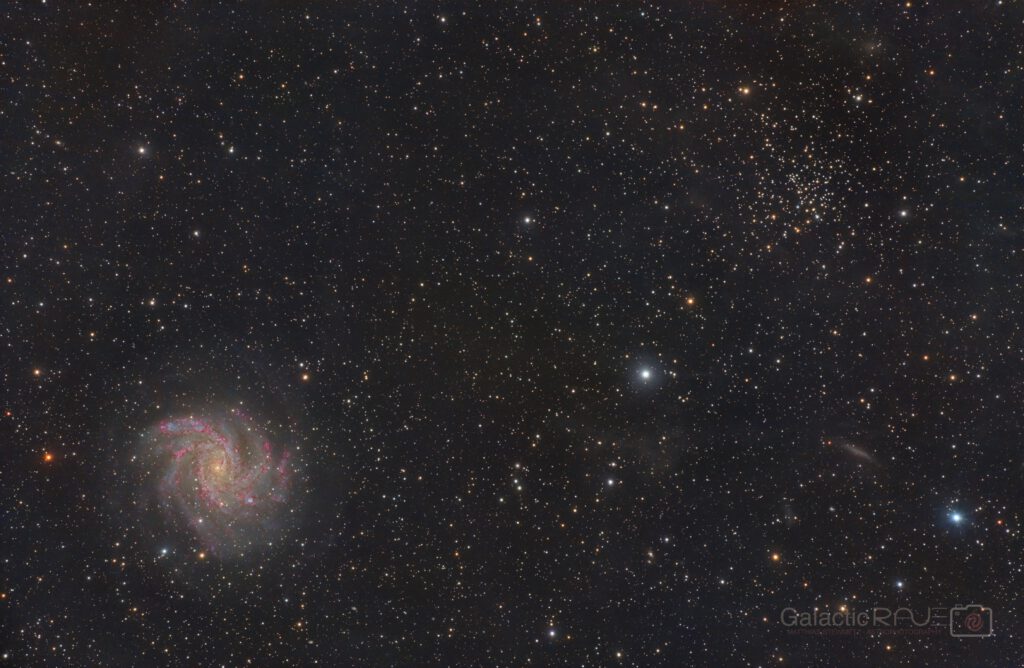
At times, the cosmos gives us unusual perspectives, and one of my favorite perspectives is the chance alignment of near and far objects. A particularly nice example is the Galactic open cluster NGC 6939, which is just a lunar diameter away from the galaxy NGC 6946, often dubbed as the fireworks galaxy owing to its large and abundant HII regions - and an unusual high frequency of SN explosions, both indicative of a very high star formation history. While the fireworks galaxy thus is a very young and active galaxy, the open cluster NGC6939 is the kind of the opposite. With an age of 1-1.5 Gyrs, it is one of the oldest objects of its kind, and indeed it appears to be dominated by yellowish stars while the sparkling blue ones are basically missing.
The color of both, NGC 6946 and 6939 are however affected by considerable extinction, which also makes the age and distance estimates of NGC6939 and NGC6946 uncertain. Both objects are in the proximity of the Galactic disk, so embedded in a sea of foreground disk stars and the associated interstellar gas/Galactic cirrus (sometimes also dubbed IFN). Some hints of these Galactic cirrus are also visible in this image, e.g. below the central bright star, Making it more visible would require a considerably deeper exposure (there are a number of these on astrobin, though usually of a wider field and at lower spatial resolution), and also would a bit distract from the two main players of this image - maybe next summer ...
Besides these objects there is also quite a number of faint background galaxies in the image, in particular the two quite extended galaxies PGC64824 (edge on) and PGC166192 (face on) between the two bright stars in the lower right quadrant (see revision A for an annotated (slightly earlier) version of the image) .
Observation Notes
In order to get both objects into one frame with my Edge 11, I had to use the Celestron 0.7 reducer. I am no particular friend of this piece of hardware, as the optical quality is wanting. The optical quality of the native EDGE11 is much better, which is particularly visible in the star images. But here the reducer comes in what it is good for - enlarging the FoV (to get higher SNR it's better to bin). And the correction only mode of BXT2.0 is quite capable to get most of the optical aberrations under control, which is crucial as the two main players are located towards the edge of the field. Not the ideal solution, but as we all know, astrophotography is living with (suboptimal) compromises ...
Data were taken on 2024 July 22, 24 and 25.
Technical Details
View the full-resolution image together with complete acquisition and processing details on AstroBin.
View on AstroBin ↗