
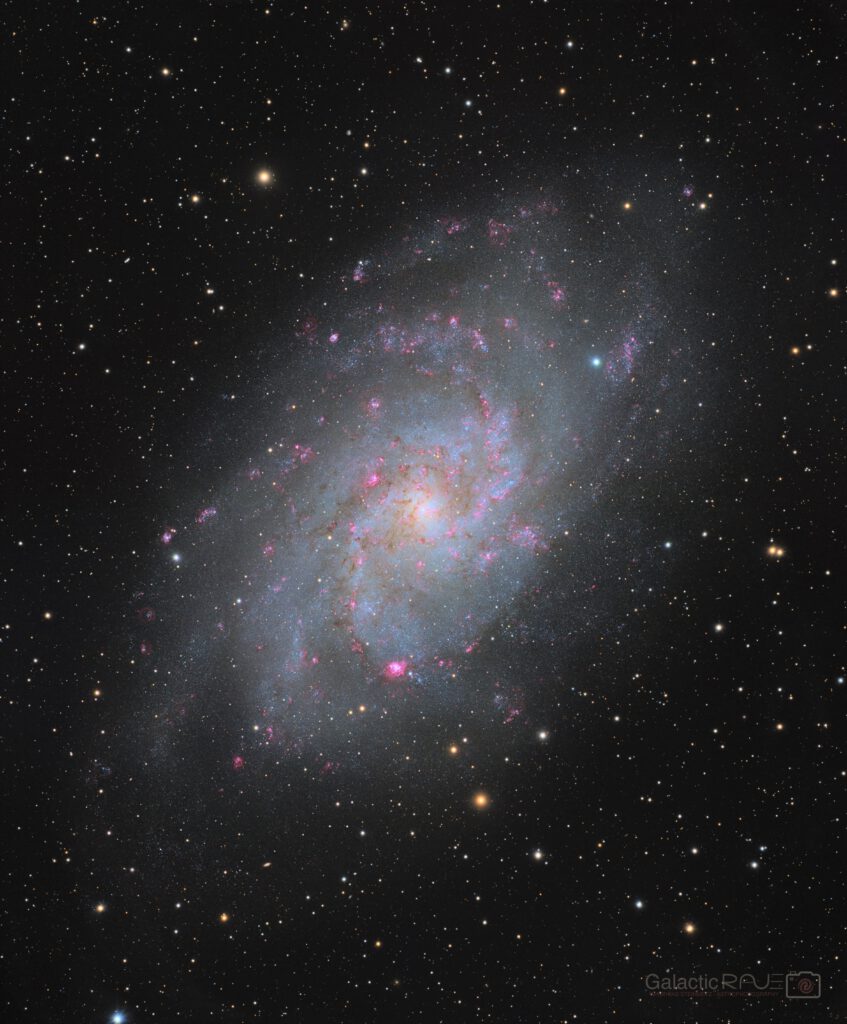
M33 – oh my God! – it is full of stars!
About the Object
About 100 years ago, Edwin Hubble used bright Cepheid stars in Andromeda (M31) to show that the mysterious "spiral nebula" are outside the Galaxy and cosmic islands as our Milky Way. The next closest major galaxy and third largest galaxy in the Local Group (after M31 and the MW) is the Triangulum galaxy M33 - at a -compared to Andromeda - about 50% larger distance of 3.2 Mly, i.e. still close enough that it can be resolved into individual star even with a small telescope (compared to the 2.5m telescope on Mt Wilson used by Hubble).
Observation Notes
M33 is a quite popular object on the autumn sky, but also a quite challenging one as it needs simultaneously a wide field of view owing to M33's angular size, but also high angular resolution in order to deeply dive into its abundance structure, which besides many stars - in particular bright blue stars in the spiral arms, also includes a substantial number of HII regions (some of them have their own IC number), while the center shows lots of brownish molecular structure. And indeed, browsing around M33 and in particular its HII regions is quite a bit of fun! So I ended up targeting with a comparably large focal length (2m using the Edge11 + reducer), a FF camera and doing a 2x1 mosaic.
Processing M33 is a continuous compromise between the extended structures formed by the gas and the large scale grainy structures formed by M33's stellar content - if you work out the one, you weaken the other and vice versa. So several times I blended two separately processed image, the one optimized for the smooth structures dominant in the central regions (ie a light hand on the stars) and the one for the grainy structures (more aggressive on the stars) - the spiral arms ... and of course Halpha (again being softer on the stars). For the inner regions I choose a Sd galaxy as a color template in SPCC - thus getting some of the yellowish/brown color tones, and for the outer spiral arms an average galaxy - so the spiral arms get stronger in the blue color tones. Hope you like it.
Data were taken on 2024 September 15, 30 and October 6, 7, 11, 15, 18, 22, and 25
Technical Details
View the full-resolution image together with complete acquisition and processing details on AstroBin.
View on AstroBin ↗