
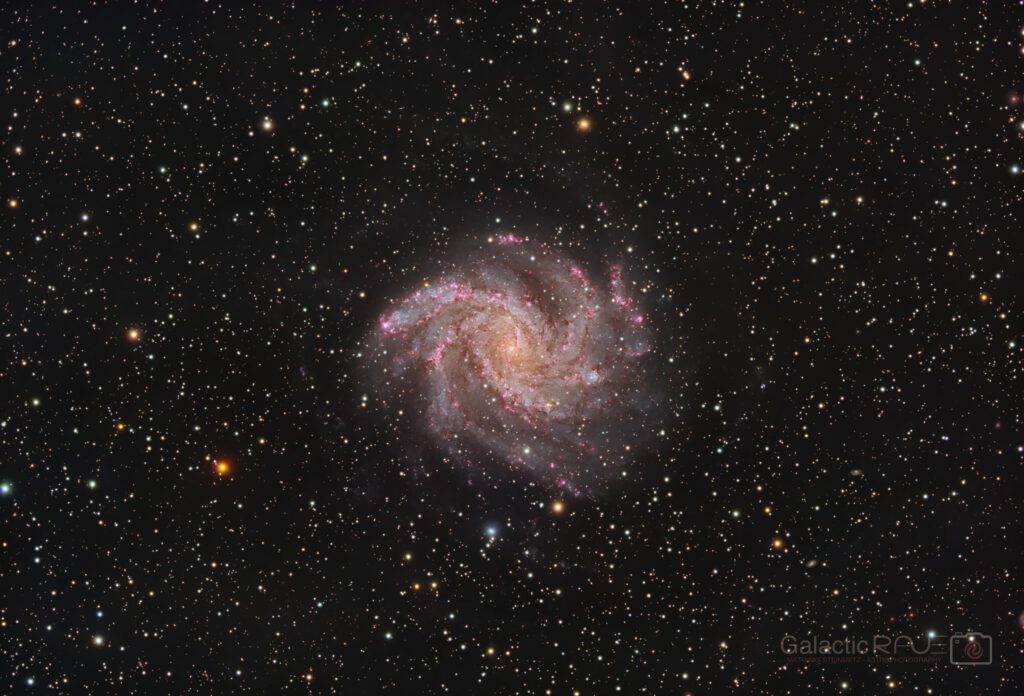
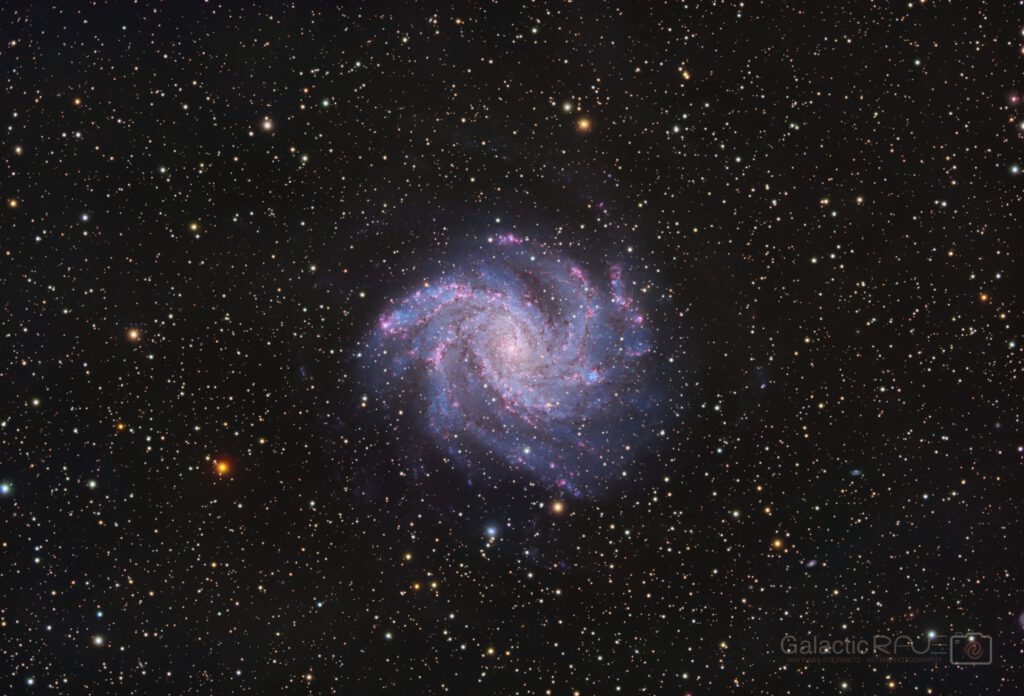
Fireworks Galaxy NGC6946 with and without Dust (animated gif)
About the Object
NGC6946 is an intermediate spiral galaxy, i.e. between the barred and unbarred kind, of fairly late type with a bright nucleus. It is known for its extensive HII regions indicative of very active star formation, and has been host of no less than 10 supernovae in the last ~100 years, thus the nickname "fireworks galaxy".
Observation Notes
This is image is creating by putting together about 38.5h of imaging data in different telescope/camera combinations on the so-called fireworks galaxy NGC6946 (also known as Arp29) - data taken also with different aim and focus - like testing new equipment, trying to understand the shortcomings of the Celestron reducer, trying to getting a larger field including the open cluster NGC6939. So I do not add the detailed information on the acquisition tab to avoid double counting.
Like the "hidden galaxy" IC342, NGC6946 is located close to the Galactic disk und thus heavily obscured by dust. Consequently, rather than showing a lot of blue colors in its spiral arms, it is more of grayish-red/brown color.
Revision B: How would NGC6946 look like if it would be located well outside the Galactic plane? Similar to my IC342 (the hidden galaxy) image from last year, I estimated the reddening in the RGB colors by using a Schlegel&Finkbeiner dust map, brightened the corresponding bands, and then followed the further process as similar as possible to the original processing.
Revision C: animated gif smoothly blending between the regular and the dereddened version
data were taken on
2021 August 11 and September 9 with Canon EOS Ra at native focal length (about 6h)
2022 October 5, 6, 7, 9, 10, 12, 15, 16, 17, 18, 19, 22 with a ASI294mm and Optolong filters using the reducer (about 23h)
2024 July 22, 24, 25 with a QHY600M, Baader filters using the reducer (about 9.5 h)
Technical Details
View the full-resolution image together with complete acquisition and processing details on AstroBin.
View on AstroBin ↗