
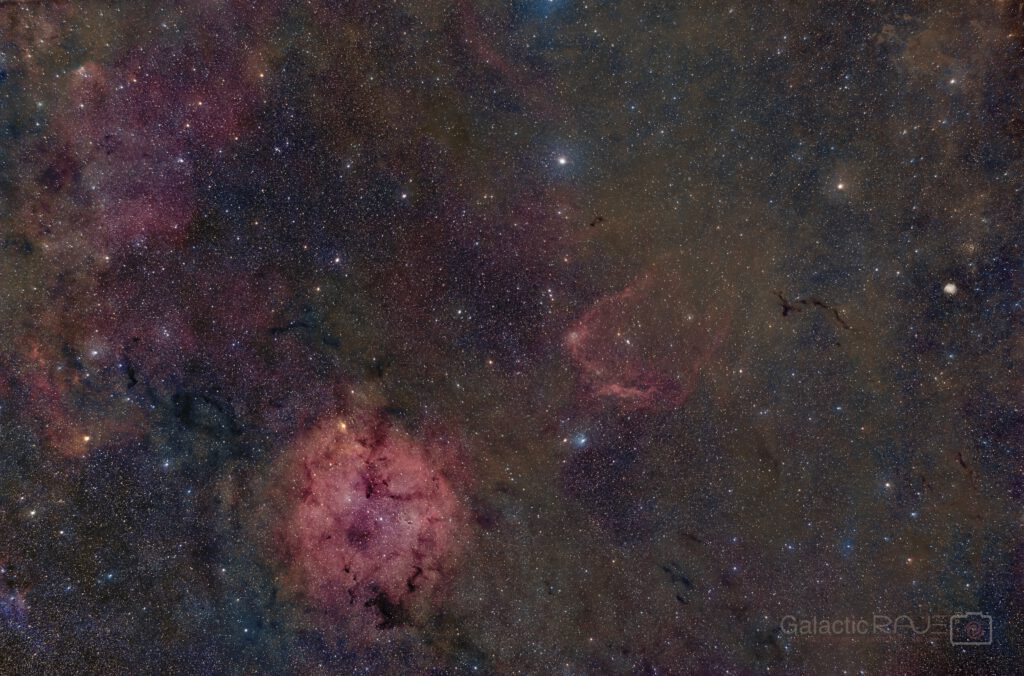
Cepheus wide field with the Samyang 135mm
About the Object
Thanks to its wide field of view (18x12 degrees), The Samyang/Rokinon 135mm is particularly well suited for some of the more busy regions of the sky - like the Cepheus region, featuring emission nebula like the Elephant trunk or the Squid nebula, dark clouds like Barnard 150, and significant galaxies like NGC 6946 and the open star cluster NGC 6939 all in one image. At the end this image which is just a data recycle project!
Observation Notes
The Samyang 135/f2.0 (or Rokinon or Wallimex) is a quite popular photolens for astrophotography. Mostly used with a crop sensor camera (ASP-C or micro 4/3, or even smaller like the ZWO 533 or the 183) it is a very portable scope with considerable reach and a superb image quality. but it also can serve Full Frame sensors, often used with DSLR/DSLM cameras, providing a very impressive large field of view but still considerable resolution. But the large field of view together with f2 comes at the price, it is very very sensitive to back focus and tilt. I am using mine together with a Canon EOS Ra, but the Samyang comes with an EF mount while the Canon DSLM have the new RF mount. I wasn't really happy with the image quality I received in the very corners (it is very good over an ASP-C or slightly larger field), but the standard photo equipment leaves only little room for fine tuning, so I decided to go for some "open heart surgery": I replaced the canon mount on the Samyang with a 48mm thread from FLO, removed the infinity stop of the Samyang so can use it with an EAF. Since Baader's RF mount to M48 adapter only consumes 28.3mm of backfocus for the Canon R series, I have 15.7mm of room to play (or 16mm if I use a L2 clip filter to suppress some internal reflections/halos), enough for a image rotator (very convenient) or, eventually, a tilter (unfortunately not both). And if I use the Samyang for landscape photograph, it directly connects now to my RF mount - nice! Tuning and testing the setup, I got some 7h of data, but with suboptimal bright stars but quite decent SNR (I am shooting wide open), so I compiled this image by putting all data together. I still have some residual tilt which I need to fight. Or in the worst case, shooting bright stars again with F2.8 or even f4 (the smaller ones fare pretty well).
Data were taken on 2023 August 9, 10 and 11
Technical Details
View the full-resolution image together with complete acquisition and processing details on AstroBin.
View on AstroBin ↗